
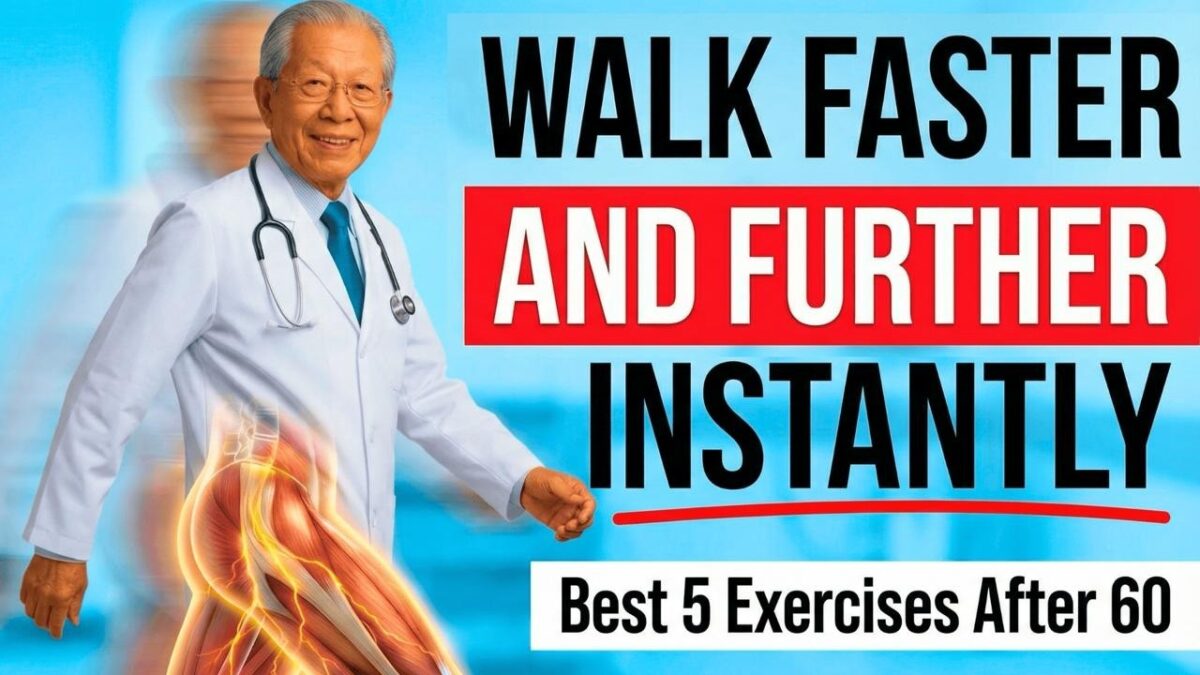
Walking speed is the “sixth vital sign” of aging, yet most seniors accept slowing down as inevitable. A landmark 2019 study in the Journal of the American Medical Association tracking over 34,000 adults found that walking speed was the single most accurate predictor of longevity—but slowing down wasn’t caused by general weakness. It was caused by the loss of two specific mechanical powers: calf propulsion (the push-off) and hip extension (the stride drive). When these mechanisms fade, walking becomes a shuffle rather than a stride.
In this episode, Japan’s oldest doctor reveals the exact five-exercise protocol to rebuild your walking engine. You’ll learn why “double support” time slows you down, how to restore the 10 degrees of hip extension needed for a full stride, and why calf strength is the #1 predictor of gait speed in adults over 70. These movements require no gym equipment and can be done at home using just a chair or wall for support.
🚦 The 30-Second Speed Test: Measure your baseline right now
🦵 Exercise 1: Alternating Heel Lifts & Marching to master weight shifting
🚀 Exercise 2: Calf Raises to restore “gas pedal” propulsion
🍑 Exercise 3: Standing Hip Extension to wake up the glute drive
🛏️ Exercise 4: Prone Hip Extension to build raw horsepower safely
🚶♂️ Exercise 5: Step Forward/Back Drill to integrate speed and rhythm
What you’ll discover:
→ Why you feel like you’re dragging your body forward instead of propelling it
→ The “Pencil Squeeze” cue that instantly activates lazy glutes
→ How to stop shuffling and start striding in just two weeks
→ The specific rep counts needed to stimulate endurance muscles
If you’ve noticed friends walking faster than you, or if a simple walk to the store feels twice as long as it used to, this episode shows you exactly how to get your speed back.
💬 COMMENT: Take the 30-second marching test in the video and drop your score below! Format: “I’m [Name] from [Country] and I did [Number] marches.”
🔔 Subscribe for weekly guidance on aging strong and staying independent.
🤍 Support the channel and become a member 👇
https://www.youtube.com/channel/UCeY8vK104Gbzp4aqnTz4gzQ/join
#WalkingSpeed #SeniorFitness #GaitTraining
TIMESTAMPS
0:00 Introduction
XX:XX Why We Slow Down After 60 + The “Engine” Theory
XX:XX Exercise 1: Weight Shifting (Marching Test)
XX:XX Exercise 2: Calf Raises (Push-Off Power)
XX:XX Exercise 3: Standing Hip Extension (The Drive)
XX:XX Exercise 4: Prone Hip Extension
XX:XX Exercise 5: Step Forward/Back Drill & Final Thoughts
Sources used for this episode:
1. Studenski, S., Perera, S., Patel, K., Rosano, C., Faulkner, K., Inzitari, M., … & Guralnik, J. M. (2011). Gait speed and survival in older adults. JAMA, 305(1), 50-58.
2. Stenroth, L., Sipilä, S., Cronin, N. J., & Rantanen, T. (2019). Plantarflexor muscle power is associated with gait speed in older women. Journal of Geriatric Physical Therapy, 42(2), 97-102.
3. Burnfield, J. M., & Powers, C. M. (2006). Prediction of walking speed in the elderly. Archives of Physical Medicine and Rehabilitation, 87(1), 112-117.
4. Franz, J. R., & Kram, R. (2013). Advanced age affects the individual leg work of walking. Clinical Biomechanics, 28(6), 671-676.
5. Shimada, H., Kim, H., Yoshida, H., Suzukawa, M., Makizako, H., Yoshida, Y., … & Suzuki, T. (2010). Factors associated with the risk of falls in the elderly community-dwelling population in Japan. Journal of Physical Therapy Science, 22(3), 243-248.
Medical Disclaimer:
1. The content provided in this video, as well as any related articles, websites, or materials, is intended for informational and educational purposes only. It is not a substitute for professional medical advice, diagnosis, or treatment. Always seek the guidance of your physician or a qualified health provider with any questions you may have regarding a medical condition.
2. Never disregard or delay seeking professional medical advice because of something you have seen or heard in our content. If you think you may be experiencing a medical emergency, call 911 or your local emergency number immediately.
3. The Senior Health Podcast does not endorse or recommend any specific tests, doctors, treatments, procedures, products, or opinions mentioned in this video or on this channel.
4. By watching this video, you acknowledge to use the information entirely at your own discretion and risk.